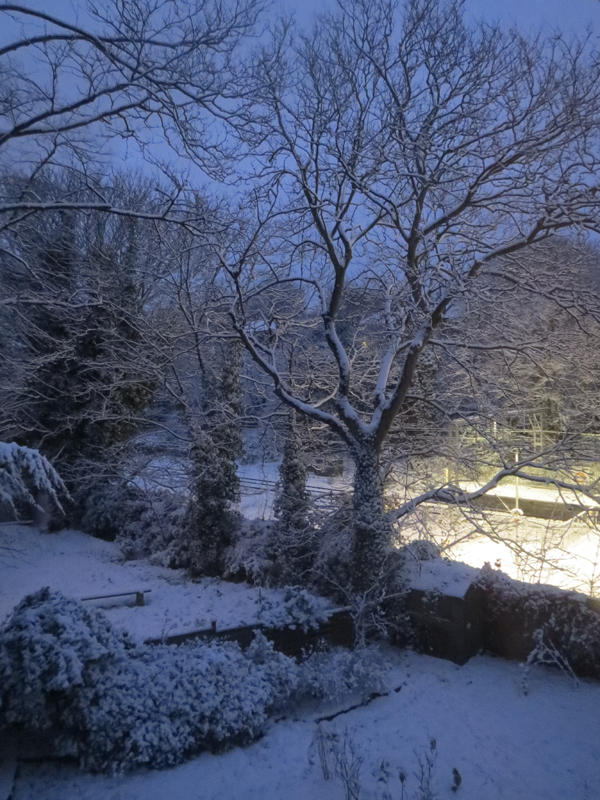
Pooh murmured to himself:
"But whatever his weight in pounds, shillings, and ounces,
He always seems bigger because of his bounces."
"And that's the whole poem," he said. "Do you like it, Piglet?"
"All except the shillings," said Piglet. "I don't think they ought to be there."
"They wanted to come in after the pounds," explained Pooh, "so I let them. It is the best way to write poetry, letting things come."
"Oh, I didn't know," said Piglet.
This is an early example of a beta reader having his advice overruled by the author. Piglet's suggestion is correct, yet the removal of the shillings would not improve the couplet.
I've reached the end of my next novel, and I've started sending it out to beta readers. I don't send it to everyone at the same time, since I'm making changes as I get feedback and I want to get comments on the latest version. (Also some of my lovely betas are doing Nanowrimo.) I'm still obsessively tweaking the fight scene, too; in my experience fights take a lot of rewriting. It's very interesting, reading betas' suggestions. I've had three reports so far, and none of them have queried the same things, and they have all made some suggestions which I have leaped upon and incorporated, and others which I have not.
The variety of responses confirms me in my view that half a dozen good betas perform better than the average editor. I write for readers, not people working in the publishing industry, so it makes sense to have readers vet my books. I imagine it's possible for an editor to become jaded, or didactic. I like a nice mix of readers and reader/writers. Readers can tell you what's wrong, and a fellow author can often tell you how to fix it.
My betas so far have liked my latest novel. This is a relief. It's lonely, writing a book, and quite worrying waiting to see what readers make of it. I hope to publish in the not-too-distant future.
Wednesday, 20 November 2013
Tuesday, 12 November 2013
The Fussy Librarian
One of the biggest problems for readers and authors is to find each other. A brand new site called The Fussy Librarian aims to help with this.
From their home page:
1. Enter your email address
2. Select what types of books you read
3. Indicate your preferences on profanity, sex and violence
4. Get daily emails & enjoy great books
5. There is no step five*
This recommendation service has been going a month, and can only get better as the choices are refined and users give feedback. (I think people's definitions of mild profanity and non-explicit scenes of sex can vary wildly, and examples would help.) Jeffrey Bruner says they plan to keep adding categories - there are currently thirty - and content options.
I think this could be good - I've joined, and you can too, here.
* I want a step five!
From their home page:
1. Enter your email address
2. Select what types of books you read
3. Indicate your preferences on profanity, sex and violence
4. Get daily emails & enjoy great books
5. There is no step five*
This recommendation service has been going a month, and can only get better as the choices are refined and users give feedback. (I think people's definitions of mild profanity and non-explicit scenes of sex can vary wildly, and examples would help.) Jeffrey Bruner says they plan to keep adding categories - there are currently thirty - and content options.
I think this could be good - I've joined, and you can too, here.
* I want a step five!
Monday, 4 November 2013
Do not trifle with readers' expectations
A couple of weeks ago Harper Collins published the third and final book, Allegiant, in Veronica Roth's popular trilogy. I'd actually bought a copy of the first book, Divergent, and got several chapters in when a horrible certainty came to me that Roth had sold the book as "Harry Potter meets The Hunger Games," and I went right off it.
Currently Allegiant is at number 5 in the US Kindle Store; it has 2,040 reviews with an average of 2.8 stars. Why the huge sales and the low customer ratings? Because Veronica Roth chose to end the series in a way that her readers hated. Here is a typical comment:
"I loved Divergent and Insurgent and was really looking forward to Allegiant. I don't recommend this book to anyone unless you want to be distraught and depressed for days afterwards. The first 300 pages are boring and totally detached from the plot of the first two books. The book picks up in the end only to leave the readers broken-hearted. There is no happy ending. There is no real closure. The author can do anything she wants with the final book and needless to say, I really dislike Veronica Roth as an author after reading this. Why end a once epic trilogy this way? I read books to be entertained and I was far from entertained. I recommend readers only reading the first two books and making up their own ending."
There is a compact between writers and readers; the reader will suspend disbelief, the writer will be true to the characters and the genre. How would we feel if Bertie Wooster suddenly murdered his Aunt Agatha? We would feel indignant and cheated, just like Roth's fans. I think there is an urge successful writers sometimes have to demonstrate they are really serious artists, prepared to shock and confound expectations. Doing this is generally a mistake.
It happens with screen writers, too. I still remember the final episode of MASH, where the writers, assured of a vast audience, decided to go all serious. Then there's the episode of Cheers where Sam discovers the dishy young woman accompanying an old friend is not his girlfriend but his daughter, and feels old and alone. This glum stuff is not what we watch Cheers for - we want to be amused, that's all.
It's difficult enough to write a good book without being wilful. Don't be wilful. Readers will not forgive you.
Currently Allegiant is at number 5 in the US Kindle Store; it has 2,040 reviews with an average of 2.8 stars. Why the huge sales and the low customer ratings? Because Veronica Roth chose to end the series in a way that her readers hated. Here is a typical comment:
"I loved Divergent and Insurgent and was really looking forward to Allegiant. I don't recommend this book to anyone unless you want to be distraught and depressed for days afterwards. The first 300 pages are boring and totally detached from the plot of the first two books. The book picks up in the end only to leave the readers broken-hearted. There is no happy ending. There is no real closure. The author can do anything she wants with the final book and needless to say, I really dislike Veronica Roth as an author after reading this. Why end a once epic trilogy this way? I read books to be entertained and I was far from entertained. I recommend readers only reading the first two books and making up their own ending."
There is a compact between writers and readers; the reader will suspend disbelief, the writer will be true to the characters and the genre. How would we feel if Bertie Wooster suddenly murdered his Aunt Agatha? We would feel indignant and cheated, just like Roth's fans. I think there is an urge successful writers sometimes have to demonstrate they are really serious artists, prepared to shock and confound expectations. Doing this is generally a mistake.
It happens with screen writers, too. I still remember the final episode of MASH, where the writers, assured of a vast audience, decided to go all serious. Then there's the episode of Cheers where Sam discovers the dishy young woman accompanying an old friend is not his girlfriend but his daughter, and feels old and alone. This glum stuff is not what we watch Cheers for - we want to be amused, that's all.
It's difficult enough to write a good book without being wilful. Don't be wilful. Readers will not forgive you.
Saturday, 19 October 2013
Writers' & Artists' Yearbook, farewell and good riddance
I last thought it essential to possess a copy of Writers' & Artists' Yearbook in 2008. I was no doubt happy to hand over my £14.99 for their 101st edition, believing this was a step towards becoming a published author. Flicking through it now, it strikes me as all rather quaint.
Here's Alison Baverstock, writing a piece on How to attract the attention of a literary agent: "Think not what an agent can do for you, but what you can do for an agent", which is the exact opposite of my advice of what to ask an interested agent: "What can you do for me?" There's all the usual stuff about doing your research, meekly sending exactly what the agent wants, and waiting patiently and not bothering her as the months trail by. It's not called submission for nothing.
Little mention, in 2008, of self-publishing; one article mentions POD, with no suggestions as to how a writer can sell the books once they are printed.
In my copy I see I've turned down corners, crossed out non-fiction agents, and put lines and stars by the possibilities. So much hope: such a complete waste of time, effort, stationery, ink cartridges and stamps.
These days, Writers' & Artists' recognizes that a huge chunk of publishing is self-publishing, and have even got a section offering would-be indie authors advice. Unfortunately they, like most of the large publishers, have done a deal with the devil, Author Solutions (now owned by Random Penguin). A new writer filling in their handy form is very likely to be recommended to use one of the 'self-publishing services' of Author Solutions or one of their alter egos. He will then find himself subjected to a hard sell, and paying thousands of pounds for inferior and useless 'services' he doesn't need or could get cheaply elsewhere. He will end up sadder, wiser, and considerably poorer.
For more detail on W & A's perfidy, see David Gaughran, here.
And my old copy of Writers' & Artists' Yearbook 2008 is going in the bin where it belongs.
Here's Alison Baverstock, writing a piece on How to attract the attention of a literary agent: "Think not what an agent can do for you, but what you can do for an agent", which is the exact opposite of my advice of what to ask an interested agent: "What can you do for me?" There's all the usual stuff about doing your research, meekly sending exactly what the agent wants, and waiting patiently and not bothering her as the months trail by. It's not called submission for nothing.
Little mention, in 2008, of self-publishing; one article mentions POD, with no suggestions as to how a writer can sell the books once they are printed.
In my copy I see I've turned down corners, crossed out non-fiction agents, and put lines and stars by the possibilities. So much hope: such a complete waste of time, effort, stationery, ink cartridges and stamps.
These days, Writers' & Artists' recognizes that a huge chunk of publishing is self-publishing, and have even got a section offering would-be indie authors advice. Unfortunately they, like most of the large publishers, have done a deal with the devil, Author Solutions (now owned by Random Penguin). A new writer filling in their handy form is very likely to be recommended to use one of the 'self-publishing services' of Author Solutions or one of their alter egos. He will then find himself subjected to a hard sell, and paying thousands of pounds for inferior and useless 'services' he doesn't need or could get cheaply elsewhere. He will end up sadder, wiser, and considerably poorer.
For more detail on W & A's perfidy, see David Gaughran, here.
And my old copy of Writers' & Artists' Yearbook 2008 is going in the bin where it belongs.
Sunday, 13 October 2013
The WIP's progress: 60,000 words
And today I hit the magic 60,000 word mark, which is my personal point of no return. It's not that all is plain sailing from here to the end of the book; I haven't written the end yet and I'm going to have to change some of what I've already written. It's just that if I get that far, barring accidents and disasters, I'm going to finish the darned thing whatever problems I encounter.
Because it's a lot of work, attempting to pick the right 60,000 words and get them in the right order.
Monday, 30 September 2013
One word after another
For me these days the most difficult part of writing a novel is getting going on the first page. I don't recall having this problem with my first two novels, when I was still in the drunken woohoo isn't writing amazing stage. Now just deciding which novel to write can take me months.
With the WIP, I finally cracked it by taking the excellent advice of Jerry Cleaver in his book, Immediate Fiction. You commit five minutes a day to your novel; you also think about it before you go to sleep. And if you don't know what to write, that's fine, you just sit and do nothing for five minutes. If you want to work for longer, that's fine too. You do this religiously for thirty days without evaluating the plan's effectiveness.
I think this method works so well because it gets the subconscious working on the book - and it's totally unthreatening. Anyone, no matter how busy, can find five minutes a day and do nothing. After thirty days I'd got a pile of notes and the novel was under way. My average word count is 480 per day, and the end is in view.
When you get right down to it, writing a novel is as simple as taking the White King's advice in Alice's Adventures in Wonderland:
The White Rabbit put on his spectacles. "Where shall I begin, please, your Majesty?" he asked.
"Begin at the beginning," the King said gravely, "and go on till you come to the end: then stop."
With the WIP, I finally cracked it by taking the excellent advice of Jerry Cleaver in his book, Immediate Fiction. You commit five minutes a day to your novel; you also think about it before you go to sleep. And if you don't know what to write, that's fine, you just sit and do nothing for five minutes. If you want to work for longer, that's fine too. You do this religiously for thirty days without evaluating the plan's effectiveness.
I think this method works so well because it gets the subconscious working on the book - and it's totally unthreatening. Anyone, no matter how busy, can find five minutes a day and do nothing. After thirty days I'd got a pile of notes and the novel was under way. My average word count is 480 per day, and the end is in view.
When you get right down to it, writing a novel is as simple as taking the White King's advice in Alice's Adventures in Wonderland:
The White Rabbit put on his spectacles. "Where shall I begin, please, your Majesty?" he asked.
"Begin at the beginning," the King said gravely, "and go on till you come to the end: then stop."
Wednesday, 25 September 2013
Smells in novels ~ but not much in Jane Austen
Smell is one of the senses we are told to use when writing a novel, and I totally agree; what can be more evocative than the smell of the sea, or honeysuckle, or a sudden whiff of the aftershave used by a long-departed boyfriend? But in the middle of the night when I should have been sleeping I had a revelation - there are very few mentions of what things smell like in Jane Austen's novels. This from Emma is par for the course:
Never had the exquisite sight, smell, sensation of nature, tranquil, warm, and brilliant after a storm, been more attractive to her.
There must be a reason for this. Smells must have been very different in Jane Austen's day, and I wonder if it was not thought genteel to comment on them.
We are somewhat smug these days about smell - after all, London smells of cars, a mixture of exhaust, tyre particles and petrol, and before owners were compelled to pick up after their dogs, on a hot day Hyde Park had a distinct reek of dog excrement. When my daughter was small I remember constantly trying to stop her accidentally treading in it on the pavement. My workshop is in Hoxton, an area with a vibrant nightlife, and while women seem able to wait to get home to have a pee, many men don't. But it's unarguable that we wash more than the people in Regency times, simply because it's much easier for us to keep clean with running hot water, soap, shampoo, toothpaste, electric toothbrushes and deodorant. So when Jane Austen describes a ball, we can only imagine the smells as the room got warmer and dancers more heated. She is not going to mention them.
How fortunate for us we live in less correct times and are allowed to describe everything our senses record. Any writers reading this are welcome to post a brief extract from their novels that deals with smells, nice or nasty.
Wednesday, 11 September 2013
Writing middles, Clippit, and increasing eccentricity
I use Word 2000. It's what I'm used to; I've written five novels on it. I actually uninstalled Word 2007 from my laptop to stick with what I know. (Unadventurous? Moi?)
And one benefit you don't get on modern versions of Word or fancy programs like Scrivener is the Office Assistant. I like Clippit. There, I've said it. I know he has enemies, but it's a lonely business, writing a novel, and you do tend to go a bit mad. (Okay, maybe it's just me. You're probably as sane as when you started.) But I am soothed by Clippit's friendly, helpful presence. Even when I've been staring so long at a blank screen that he curls up and goes to sleep, a silent comment on my lack of productivity, I know at the tap of a key he will spring to attention, ready to make suggestions, my little virtual friend.
In Muriel Spark's novel, A Far Cry From Kensington, it is suggested by the protagonist who works in publishing that a cat is an aid to writing - though she does add, a cat won't actually write the book for you, or guarantee it will be any good. Clippit serves the same function, but you don't have to feed him and take him to the vet, and if you find you are arguing with him more than seems reasonable, you can always switch him off for a while.
And one benefit you don't get on modern versions of Word or fancy programs like Scrivener is the Office Assistant. I like Clippit. There, I've said it. I know he has enemies, but it's a lonely business, writing a novel, and you do tend to go a bit mad. (Okay, maybe it's just me. You're probably as sane as when you started.) But I am soothed by Clippit's friendly, helpful presence. Even when I've been staring so long at a blank screen that he curls up and goes to sleep, a silent comment on my lack of productivity, I know at the tap of a key he will spring to attention, ready to make suggestions, my little virtual friend.
In Muriel Spark's novel, A Far Cry From Kensington, it is suggested by the protagonist who works in publishing that a cat is an aid to writing - though she does add, a cat won't actually write the book for you, or guarantee it will be any good. Clippit serves the same function, but you don't have to feed him and take him to the vet, and if you find you are arguing with him more than seems reasonable, you can always switch him off for a while.
Friday, 6 September 2013
Writing - never mind the quality, feel the width
![]() |
| Lucie Rie conical bowl, 1978 |
"Listen," he said. "I don't care a damn what any of you are called, but if there's another word from anyone I shall keep you all in this afternoon."
"You can't keep me in," said Clutterbuck; "I'm going for a walk with Captain Grimes."
"Then I shall very nearly kill you with this stick. Meanwhile you will all write an essay on 'Self-indulgence'. There will be a prize of half a crown for the longest essay, irrespective of any possible merit."
From then onwards all was silence until break. Paul, still holding his stick, gazed despondently out of the window. Now and then there rose from below the shrill voices of the servants scolding each other in Welsh. By the time the bell rang Clutterbuck had covered sixteen pages, and was awarded the half-crown.
"Did you find those boys difficult to manage?" asked Mr Prendergast, filling his pipe.
"Not at all," said Paul.
Apart from its refreshing lack of political correctness of any kind, this extract contains a writing tip: stop trying so hard and just get on with it. Even if no one is offering you a half crown.
In Art and Fear, Ted Orland and David Bayles tell the story of a ceramics teacher who told his class that half of them would be graded on the quantity of pots they created and the other half on the quality. At the end of the term, the results were interesting. Freed from the pressure of straining for excellence, making good and bad pots, practising and learning from their mistakes, it was the quantity group who produced the best pots.
Saturday, 24 August 2013
How to get a publishing contract
What are the publishable classes? It's an expression coined by my virtual friend, Iain Manson, and means the sort of people who find it relatively easy to get an agent and a publishing deal, unlike most of us who find it next to impossible. It includes (and I'm relying on Iain to tell me if I've missed a category):
- Journalists
- Anyone with a contact in publishing
- Anyone famous for something other than writing
- Anyone related to someone famous
Recent examples include 21 year-old Samantha Shannon; from the Guardian article: "Her father knew someone in touch with literary agent David Godwin and, after an email exchange, he agreed to look at her manuscript. He was 'kind' about it but also turned the book down. Yet it was this connection that would not long afterwards lead to Shannon doing a two-week summer internship with his agency (in Seven Dials, Covent Garden), which was to prove illuminating about 'how the industry works'." David Godwin subsequently became her agent and sold the first three novels in her fantasy series to Bloomsbury for a six-figure sum.
Lottie Moggach is doubly qualified by being a journalist and daughter of Deborah Moggach, the successful writer. Her first novel, Kiss Me First, has recently been published by Picador.
Then there's promising newcomer JK Galbraith, who turned out to have got a deal for his first crime novel by actually being JK Rowling.
I haven't read any of these books, and I'm not implying they are not excellent and worthy of a publishing contract. But I think this nepotism matters, because the pool from which publishers select authors is in reality quite small, however vast the slush pile may be. It seems to me self-evident that there are many equally good or better writers who are rejected time and again after a cursory glance by an intern. And these days when the future of Big Publishing is uncertain, they cannot afford to miss the next Big Thing just because it happens to have been written by a nobody.
P.S. On a happier note, self-publication has again proved the best way to go for most of us. Steve Robinson has accepted an offer from Amazon for a four book deal with an option on book five following the huge popularity of his genealogical crime series, now on special offer. Go Steve!
Friday, 9 August 2013
My 3rd self-publishing anniversary
This day three years ago I self-published Remix on Amazon.
Self-publishing wasn't what I really wanted. I believe I still hankered after the dream - an agent, a publisher, a stack of books in a bookshop which I could go and secretly gloat over, maybe a desk, a pen, a queue of fans...
But the dream had made it clear it didn't want anything to do with me. I couldn't even get to first base and find an agent to take me on, though several trifled with me.
So I gritted the teeth, concocted a cover, worked out how to format for Smashwords and KDP, and committed to the move.
Back then - and how quaint it seems now - writers on forums would give dire warnings that you were using up your first publication rights (que?) and said no big publisher would consider a book once it had been self-published (pause for raucous laughter). They also opined that no book without the input of a publisher's team of editors, designers and marketers would A) be any good and B) sell any copies.
How wrong they were. Those of us who jumped in at that point caught the first wave of indie opportunity, a boom time that will never happen again. So favourable to popular books were Amazon's algorithms in those days that Remix spent over eight months in the UK top 100.
Now that almost everyone agrees that self-publishing is a valid way for a writer to proceed, it's way tougher to make an impact on the charts. Three years ago, I was lucky.
Self-publishing wasn't what I really wanted. I believe I still hankered after the dream - an agent, a publisher, a stack of books in a bookshop which I could go and secretly gloat over, maybe a desk, a pen, a queue of fans...
But the dream had made it clear it didn't want anything to do with me. I couldn't even get to first base and find an agent to take me on, though several trifled with me.
So I gritted the teeth, concocted a cover, worked out how to format for Smashwords and KDP, and committed to the move.
Back then - and how quaint it seems now - writers on forums would give dire warnings that you were using up your first publication rights (que?) and said no big publisher would consider a book once it had been self-published (pause for raucous laughter). They also opined that no book without the input of a publisher's team of editors, designers and marketers would A) be any good and B) sell any copies.How wrong they were. Those of us who jumped in at that point caught the first wave of indie opportunity, a boom time that will never happen again. So favourable to popular books were Amazon's algorithms in those days that Remix spent over eight months in the UK top 100.
Now that almost everyone agrees that self-publishing is a valid way for a writer to proceed, it's way tougher to make an impact on the charts. Three years ago, I was lucky.
Friday, 26 July 2013
REMIX, the Hungarian hardback
Yesterday the Hungarian hardback edition of Remix arrived through the post. A proud moment. So far, Könyvmolyképző Kiadó's is the only hardback version of any of my novels.
Remix has had quite a few covers in its time, and it's interesting that this one has more the feel of my early ones. The title is in raised lettering. My heroine Caz looks very sultry, which I think would amuse her. I particularly like the dedication:
Mintynek
Köszönet minden Ãro barátomnak – ti tudjátok, kikre gondolok...
TRANSLATION
For Minty
With thanks to all my writing friends - you know who you are...
Tuesday, 23 July 2013
Chris Blake is a fake - lying author biographies
We all know that JK Rowling made up an elaborate identity for her alter ego, Robert Galbraith, including claims that he was married with two sons, and had worked in the Special Investigation Branch of the Royal Military Police. This caused a stir in America, where it is thought very bad form indeed to impersonate military personnel.
I've just come across another instance of, well, lying about the identity of an author in such a way as to persuade a potential reader to buy the book. It's an interesting story.
Carl Ashmore wrote a children's series called The Time Hunters. He self-published and did well with it, but before this he put it on the writers' site Authonomy, where in 2010 it won a gold star and a critique by an anonymous Harper Collins editor. The editor said, 'I really enjoyed reading THE TIME HUNTERS. You start off the action with a bang, drawing the reader in right away. Your writing is strong, and in places has a classic feel.... It has terrific potential.'
Maybe Carl's book impressed that editor a little too much. Three years later, Harper Collins has published a children's series called Time Hunters, which bears some similarities to Carl's original version. Coincidence? Harper Collins had put together the idea, titles and outlines for the books, and contracted a writer via Hothouse Fiction to write them for a flat fee. (The author - female - told Carl she had not read his novels.) Three years is about the time you'd expect for trad publishing to commission and bring three books to market.
And Harper Collins made up this artful and completely false bio for its new 'author', which you can read on the book's Amazon page:
About the Author
Chris Blake lives in the South West, not far from Tintagel Castle, rumoured to be the home of King Arthur. Ever since he was a little boy Chris has always dreamed about travelling through time. He likes watching Doctor Who and looks forward to the day that time-travel is possible as he’d love to visit all the places in his books. In the meantime Chris will keep writing his own adventures. Chris has an old black cat called Merlin.
I realize I take author bios at face value. Mine is honest, and I assume others are too. Perhaps I am wrong, and some don't give a damn about veracity, just write whatever bio they think will sell most books. I don't think much of that.
Read Carl's post on the subject here.
Friday, 19 July 2013
The home life of Russian oligarchs
While researching my latest novel, I came across this commercial. I love the giraffe.
Sunday, 14 July 2013
JK Rowling publishes (briefly) under another name
I don't expect I'm breaking this news to anyone. But it does strike me as raising a number of interesting questions.
Kate Mills, fiction editor at Orion Books, admitted she had turned down the crime novel, which she described as well-written but quiet. She tweeted: So, I can now say that I turned down JK Rowling. I did read and say no to Cuckoo's Calling. Anyone else going to confess?
JKR published with Sphere, part of Little, Brown Book Group which published The Casual Vacancy. So does this mean she tried to find a publisher using only her nom de plume, Robert Galbraith, but failed and had to turn to her own publisher - who would naturally be eager to publish a new JKR?
The Cuckoo's Calling launched 18th April 2013, with many glowing reviews from reviewers who would normally be reluctant to read a newbie author. Were they tipped off? Or did Little, Brown just push the book very hard, having paid a lot up front?
Until the revelation today, sales were modest and the book had only a handful of readers' reviews on Amazon. Author Ian Rankin wrote: "So a debut novelist, garnering good quotes from famed authors for the cover plus good reviews, can expect to sell only a few hundred copies."
So who let the cat out of the bag? It must have been terribly frustrating for the publishers, watching the book sitting there, knowing with just a few words it could be selling thousands of copies per day...
The novel comes with a fake author bio: Born in 1968, Robert Galbraith is married with two sons. After several years with the Royal Military Police, he was attached to the SIB (Special Investigation Branch), the plain-clothes branch of the RMP. He left the military in 2003 and has been working since then in the civilian security industry. The idea for protagonist Cormoran Strike grew directly out of his own experiences and those of his military friends who have returned to the civilian world. 'Robert Galbraith' is a pseudonym. (Seems unnecessarily deceptive to me.)
The "Movers and Shakers" section of Amazon, which charts gains in sales by the hour, says sales of the book are currently up by more than 507,000%.
Wednesday, 26 June 2013
Fame, lasting and fleeting
Which would you rather: to be a rich and famous novelist during your lifetime, then sink into obscurity for ever, or struggle while alive and then have everlasting popularity and prestige? Galsworthy or Austen?
I doubt the best-selling vampire and zombie novels will be more than curiosities fifty years from now. Harry Potter just might become a classic, though in my opinion the later books are less entertaining than the early ones. Room, Before I Go To Sleep, and Gone Girl seem to me, gripping though they are, unlikely to last. What do you think? Nominations for lasting/non-lasting contemporary novels in the comments, please.
I hesitantly believe that long term, the public has excellent taste. Shakespeare is valued and Thomas Kyd, Christopher Marlowe, Ben Jonson, Francis Beaumont and John Fletcher all but forgotten. But ... a book has to be published, even if it doesn't sell well during the author's life, to have any hope of becoming lastingly popular. Paintings don't have this problem - see Van Gogh. Had Jane Austen's novels just been circulated among her family, she would be unknown today, to the great loss of the reading public. Which makes me wonder how many terrific books which failed to find a publisher in the last half-century languish in drawers or forgotten in attics, never to find their readers. Thanks to Jeff Bezos, this is far less likely to happen these days.
Tuesday, 18 June 2013
Sex in novels - more! No, less!
After the inexplicable success of 50 Shades of Grey, some writers are making their romances more sexually explicit, or penning erotica to cater to what they perceive the market wants. (I stoutly maintain that erotica is in its own category, quite separate from other fiction, and different rules apply. For one thing, it's much easier to sell, so perhaps these authors are making a canny move.) As a reader, it's not for me, for much the same reason I don't like musicals; the actors keep stopping to sing instead of getting on with the story.
But while some categories are getting steamier, new chaste ones are popping up. I only heard of Amish Romance recently via Passive Guy's post Why Amish Novels Are Hot, but there's a lot of it about. You can recognize the genre as the covers generally show a young woman in one of those white bonnets with strings looking wistful. Author Sarah Stegall commented on its appeal:
"It's an under-served market. My mother-in-law is not Amish, but grew up in that country and is an avid reader of Amish romances. She says the appeal of such stories, for her and her friends, is the lack of sex and profanity. These ladies are very uncomfortable with currently published romance novels, which qualify (to her) as pornography. She likes courtship stories, sweet adolescent romance stories, and such. Her friends also like the emphasis on religion, rather than worldly values. And yes, all of these ladies read their Amish romances on Kindles."
So there we go. I'm guilty myself of 'profanity' in my novels; I'm pleased that these days characters don't have to say 'mucking' as a makeshift alternative like Reg does in Mary Renault's excellent novel, The Charioteer. (On a side note, I cannot believe her dozy publishers have not released her books as ebooks. Or that the paperback has such a terrible cover.)
Just to confuse, there is also a steamy sub-genre of Amish romances, Gay Amish Romance. Something for every reader's taste.
While I was trawling the internet for illustrations for this post (the trouble I go to) I came across an ace site, Bad Romance Covers. Though not strictly relevant, I could not resist the cover on the right, When Dachshunds Ruled the Serengeti.
Now that's a title you wouldn't need to check to see if it had been used before...
But while some categories are getting steamier, new chaste ones are popping up. I only heard of Amish Romance recently via Passive Guy's post Why Amish Novels Are Hot, but there's a lot of it about. You can recognize the genre as the covers generally show a young woman in one of those white bonnets with strings looking wistful. Author Sarah Stegall commented on its appeal:
"It's an under-served market. My mother-in-law is not Amish, but grew up in that country and is an avid reader of Amish romances. She says the appeal of such stories, for her and her friends, is the lack of sex and profanity. These ladies are very uncomfortable with currently published romance novels, which qualify (to her) as pornography. She likes courtship stories, sweet adolescent romance stories, and such. Her friends also like the emphasis on religion, rather than worldly values. And yes, all of these ladies read their Amish romances on Kindles."
So there we go. I'm guilty myself of 'profanity' in my novels; I'm pleased that these days characters don't have to say 'mucking' as a makeshift alternative like Reg does in Mary Renault's excellent novel, The Charioteer. (On a side note, I cannot believe her dozy publishers have not released her books as ebooks. Or that the paperback has such a terrible cover.)Just to confuse, there is also a steamy sub-genre of Amish romances, Gay Amish Romance. Something for every reader's taste.
While I was trawling the internet for illustrations for this post (the trouble I go to) I came across an ace site, Bad Romance Covers. Though not strictly relevant, I could not resist the cover on the right, When Dachshunds Ruled the Serengeti.
Now that's a title you wouldn't need to check to see if it had been used before...
Saturday, 8 June 2013
Versions of reality
![]() |
| The railway behind my/Beth's flat in the snow |
Beth's flat in Replica is based on my flat, including the non-working entry phone so Beth has to open a window and lean out to see who has rung her bell. Beth Two's dash through the gardens on to the railway station describes the layout as it was when I wrote it, though the station is now larger. (Nothing in London stays the same for long.)
Chatting about Replica to the offspring's boyfriend, I asked him how he'd imagined Beth's flat. "I think of it as this one," he said. And it occurred to me, he was one of only a handful of readers who would have exactly the same picture in his head of Beth's home and Beth Two's escape as I did.
Of course, this doesn't matter at all. If an author has done his job properly, the right reader will be able to imagine the scene correctly, though with variations. I can work out when I read some of my favourite books from the settings that come to mind, borrowed from where I was living at the time. Quite unlike films, where we all picture the characters and settings as we have seen them on the screen.
It's strange to think of the thousands of different versions of my novels that play in people's heads, as each reader brings his or her unique experience of life to my fiction.
Saturday, 1 June 2013
Draft2Digital and leaving KDP Select
When KDP Select started at the end of 2011, I was an early adopter. My books had sold very well on Amazon, while selling hardly any via Smashwords, so the decision was a no-brainer for me. And at the start of 2012 it enabled me to sell huge quantities of ebooks at a higher price than I'd been able to charge before, as well as making money from Kindle Owners' Lending Library (KOLL).
But what has it done for me lately? Over the past year, the benefits of KDP Select have dwindled, and Amazon has not yet offered anything to replace them. I'm not criticizing Amazon; Jeff Bezos runs his business extremely well, and has no obligation to promote my books for me. It's possible that Amazon no longer needs indie authors in the same way after the DoJ's judgement against the Price-Fix Six. I'm grateful for the opportunities Amazon has put my way, enabling me to prove there is a market for my writing and make quite a bit of money.
But though I expect most of my future sales still to come via Amazon, it may be time to branch out. Last week I came across a long article on Survivorship Bias, including this observation:
Lucky people tend to constantly change routines and seek out new experiences. The lucky try more things, and fail more often, but when they fail they shrug it off and try something else.
These days there is an alternative to Smashwords' clunky meatgrinder: Draft2Digital. Its site is classy, non-buggy and easy to use, its terms eminently reasonable. Support is fast and helpful. D2D's software converts your Word document into an ebook with a ToC and chapter breaks. Five of my six books reached the end of their three months in KDP Select yesterday, and I've now loaded them on Draft2Digital. Within the next week or two, they will go live on Barnes & Noble, Kobo and Apple's iBookstore.
I'm not expecting to sell much, at any rate initially, but I know from Statcounter that people are looking for epub versions of my novels, and now they will be able to buy them. I hope to be lucky - but if it doesn't work out, I'll try something else.
But what has it done for me lately? Over the past year, the benefits of KDP Select have dwindled, and Amazon has not yet offered anything to replace them. I'm not criticizing Amazon; Jeff Bezos runs his business extremely well, and has no obligation to promote my books for me. It's possible that Amazon no longer needs indie authors in the same way after the DoJ's judgement against the Price-Fix Six. I'm grateful for the opportunities Amazon has put my way, enabling me to prove there is a market for my writing and make quite a bit of money.
But though I expect most of my future sales still to come via Amazon, it may be time to branch out. Last week I came across a long article on Survivorship Bias, including this observation:
Lucky people tend to constantly change routines and seek out new experiences. The lucky try more things, and fail more often, but when they fail they shrug it off and try something else.
These days there is an alternative to Smashwords' clunky meatgrinder: Draft2Digital. Its site is classy, non-buggy and easy to use, its terms eminently reasonable. Support is fast and helpful. D2D's software converts your Word document into an ebook with a ToC and chapter breaks. Five of my six books reached the end of their three months in KDP Select yesterday, and I've now loaded them on Draft2Digital. Within the next week or two, they will go live on Barnes & Noble, Kobo and Apple's iBookstore.
I'm not expecting to sell much, at any rate initially, but I know from Statcounter that people are looking for epub versions of my novels, and now they will be able to buy them. I hope to be lucky - but if it doesn't work out, I'll try something else.
Tuesday, 21 May 2013
More rules I could do without
Why are some writers so fond of rules? Why are some indie writers so fond of rules? Isn't one of the main benefits of self-pubbing that you don't have to toe the line any more?
Back in 2009/10 when I was submitting Remix to agents, there were more rules than you could shake a stick at, and writers would anxiously obsess over them on forums. Double spacing yes, but should we really use ugly Courier or was Times New Roman acceptable? Agents, we knew, were captious and huffy creatures. There were lots of crimes that would result in an agent tossing your three chapters unread into the bin. These included omitting to enclose a self-addressed stamped envelope (I forgot once, and sure enough, didn't get the form rejection I was looking forward to adding to my collection). You had to study the agent's precise requirements and observe them to the letter, or she wouldn't even curl her pretty lip over your typescript.
We all did what we were told. To be fair, until Amazon changed everything we had no choice. (I may say it's still going on - read Carol Blake's handy list of 29 Ways NOT To Submit To An Agent. Reading that made me realize just how much I love not being a part of that scene any more.)
What irks me now is indies coming up with their own rules. Our book, we are told, will not be ready to publish until we have hired a professional editor, proofreader, formatter and cover designer. Not may not, but will not. Fleur Philips goes further: “One thing I feel indie or self pub authors MUST do for publicity and marketing is to hire a really good publicity firm to handle marketing and public relations ... if you can’t afford it, find a way to make it happen!” (Plih. Bog off, Fleur.) Others tell us we must write several books a year to succeed, and divide our time between marketing and writing.
To which I say, we are big grown-up indies. I can decide for myself whether or not I need to pay a proofreader (not, actually) and do all that other stuff. I do not need the new orthodoxy telling me what to do, and neither do you.
Back in 2009/10 when I was submitting Remix to agents, there were more rules than you could shake a stick at, and writers would anxiously obsess over them on forums. Double spacing yes, but should we really use ugly Courier or was Times New Roman acceptable? Agents, we knew, were captious and huffy creatures. There were lots of crimes that would result in an agent tossing your three chapters unread into the bin. These included omitting to enclose a self-addressed stamped envelope (I forgot once, and sure enough, didn't get the form rejection I was looking forward to adding to my collection). You had to study the agent's precise requirements and observe them to the letter, or she wouldn't even curl her pretty lip over your typescript.
We all did what we were told. To be fair, until Amazon changed everything we had no choice. (I may say it's still going on - read Carol Blake's handy list of 29 Ways NOT To Submit To An Agent. Reading that made me realize just how much I love not being a part of that scene any more.)
What irks me now is indies coming up with their own rules. Our book, we are told, will not be ready to publish until we have hired a professional editor, proofreader, formatter and cover designer. Not may not, but will not. Fleur Philips goes further: “One thing I feel indie or self pub authors MUST do for publicity and marketing is to hire a really good publicity firm to handle marketing and public relations ... if you can’t afford it, find a way to make it happen!” (Plih. Bog off, Fleur.) Others tell us we must write several books a year to succeed, and divide our time between marketing and writing.
To which I say, we are big grown-up indies. I can decide for myself whether or not I need to pay a proofreader (not, actually) and do all that other stuff. I do not need the new orthodoxy telling me what to do, and neither do you.
Subscribe to:
Posts (Atom)