
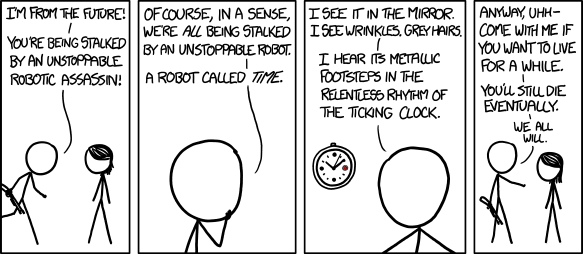
 |
| from xkcd |
Friday, 22 February 2013


Tuesday, 19 February 2013
Crisps and Chips - UK and US English

Karen, who contacted me, had made a list of unfamiliar British expressions she'd come across in my novel; she and the other members guessed the meaning then I attempted to give a definition. What struck me was how many words in use here are unknown over there - so many that I now have a new respect for my American readers. I knew about the obvious ones, like tap and faucet, boot and trunk, trousers and pants, but that's not the half of it.
One word I'd already learned about and have avoided in my later books is "jumper". In America, a jumper is a sleeveless dress worn over a blouse or sweater or a child's garment consisting of straight-legged pants attached to a biblike bodice. When Caz pulls on a sloppy jumper over her dress US readers are not visualizing her outfit as I see it. I now stick to sweater.
Jeff Pike was responsible for the most incomprehensible words as he uses slang and swears a lot. Examples: "can't be arsed," "I don't give a toss," "saddo", "tosser", "poncey", "gaff". Caz's vocabulary is milder, but "Bog off" and "bally" were puzzling.
I didn't know that in America a plaster is a bandaid. A torch is a flashlight. Karen explained that a torch means a flaming brand; the advantage is theirs, as we have to make do with one word for both. Chocolate digestives are unknown in the US, and I struggled to explain why they are called digestives (possibly advertised as good for the digestion?)
Parkour and ligger are perhaps a little obscure even in this country. Still, what good is a book if you don't learn the odd new word from it?
Tuesday, 12 February 2013
Conduct becoming a writer

We also have the opportunity to disgrace ourselves like never before, achieving instant fame of a really, really undesirable kind (see this Guardian article on poor Jacqueline Howett). Here are a few things I've learned about appearing on the internet...
- It's not good to get into rows on forums. If things start to get heated I wander off and do some useful task like the washing up. I don't have to have the last word.
- About reviews - even the wrongest person from Planet Wrong is entitled to his opinion.
- Bear in mind that people you write about will come across your remarks.
- No one needs to know what your politics are, or your religion come to that. It may put them off, even if you aren't National Front and Wicca (with apologies to all witches).
- Being polite and helpful is a Good Thing. It's also good for your image.
- Moaning and grumbling are to be avoided.
What would you add?
Friday, 18 January 2013
The appeal of post-apocalyptic fiction
 Having recently published Ice Diaries, which tells the story of a small group of survivors in a 2018 London under twenty metres of snow, I got to wondering about the popularity of post-apocalyptic novels. Why are we so willing to imagine the end of our civilization, when for most of us in the West we have never had it so good?
What is the attraction of losing everything that makes our lives easy and getting back to basics - sometimes with added zombies?
Here are my theories as to why we find a post-apocalyptic scenario appealing:
- In an increasingly Nanny state, the disappearance of tiresome rules and bureaucracy. No more parking tickets or obsessively checking the speedometer to avoid a fine or remembering to put the rubbish out on a Friday, after 5.30 but not before.
- The chance to have adventures and move out of one's comfort zone. Farewell nine to five.
- The novelty of being in a familiar setting but under hugely different circumstances.
- There is a looter and pillager deep in all of us, just waiting for an opportunity. The collapse of civilization makes looting acceptable, even necessary.
- You can, like my heroine Tori, get to choose an opulent flat to live in that you could never normally afford.
- Having to be resourceful, and having more control over one's life.
- Immediate and rough justice, instead of our flawed and expensive judicial system - whose results often, after an agonizingly long wait, amount to rough justice.
- The planet getting a rest from its biggest depradator, man.

Tuesday, 15 January 2013
ICE DIARIES ~ the paperback

Yesterday the first paperbacks of Ice Diaries arrived. Always an anxious moment, opening the package; I'd got the margins wrong on the proof copy, which meant a lot of reformatting. I was confident enough not to pay £21 for another proof, but the odd doubt lingered. I enjoy formatting for print (I do it on Word, not owning InDesign) and this time I succumbed to the lure of dropped caps. The books look good and I'm rather proud.
Though digital is undoubtedly the future, there will always be a market for print editions, and as an author I like to have a physical copy of my books.
You can buy Ice Diaries on Amazon UK for £6.99 with free postage, or $10.99 on Amazon US.
Wednesday, 2 January 2013
Persistence

My novels have been selling steadily, if not in the huge quantities they did in 2010/11, bringing my total ebook sales to over 60,000. I published a new novel. I've recently had a nice run of enthusiastic reviews, and for a writer nothing is more rewarding than knowing readers have enjoyed your books.
So I had intended to write an assessment of the highs and lows of 2012, plus hopes and predictions for 2013. It was going to be all bullet points - you'd have loved it. I did the illustration specially.
But then I changed my mind and decided to write briefly about persistence. Because in an overcrowded and competitive marketplace, persistence probably matters more than anything, including talent. It's so easy to get discouraged as a writer; sometimes the effort seems pointless. But just keeping going as others fall by the wayside puts you in an elite group, and it's from that group that successful and famous authors will emerge.
Here's a toast to 2013: health, happiness and success!
Monday, 24 December 2012

Sunday, 23 December 2012
Swoon - you may when you read the contract
SW♥♥N will be launched next spring by MacMillan Children's Publishing. It sounds a bit like a YA version of Authonomy; writers will load their unpublished novels, and other members will vote on them. The inducement is that MacMillan may publish successful books.
Anyone like me who has experience of Authonomy will view this project with a jaundiced eye. Writers are a desperate lot, and many will do anything for a chance of publication. This means it is very easy to attract them to a site run by an established publisher, and very difficult to stop them gaming the system. Another problem is that editors think they know better than readers, and tend not to put much faith in the wisdom of crowds, even when that is what they set out to do. Plus these sites are time-sinks, using energy that would be better spent writing or self-publishing.
For the 'lucky' chosen authors, this is what they will get:
Once a manuscript is chosen by the community and the SW♥♥N Reads publishing team, the author will receive a $10,000 advance and a standard royalty-based publishing contract for world rights, including the following royalty rates:
- Hardcover – 10% of list price
- Trade Paperback – 6% of list price
- Paper Over Board – 8% of list price
- Mass Market Paperback – 6% of list price
- E-book – 25% of amount received
- Graphic Book – 6% of list price
- Electronic Graphic Book – 10% of amount received
- Audio – 10% of amount received
- Digital Audio – 20% of amount received
- Multimedia/Gaming – 10% of amount received
So other people will take between 90% and 94% of the profits of each print book, leaving 6 - 10% for the author. For ebooks, which cost nothing at point of sale, the publisher takes three quarters of the 'amount received'. They will own world rights, and modern publishing contracts take the rights for a very, very long time.
Stingy and mean are words that come to mind. Exploitative, that's another. It's depressing to think that plenty of writers will view this as an opportunity.
Stingy and mean are words that come to mind. Exploitative, that's another. It's depressing to think that plenty of writers will view this as an opportunity.
Sunday, 16 December 2012
Are publishers missing a trick?

Here it is in Hugh's own words:
"After three rounds of publishers winking, flirting, and making passes at WOOL this year -- after a dozen or so offers that I would've fallen over myself to accept earlier in my career -- after walking away from two 7-figure deals last month that would've meant giving up all control of my publishing future and all of my rights -- Simon and Schuster blew my agent and myself out of the water with a deal that is everything we've been looking for from the very beginning (and never expected to get).
"Less money. More respect. Ultimate freedom.
"This is the contract I've been hoping for, and not just for myself. To be honest, I didn't think it would happen to me. I thought this was a contract for the future -- for other authors. But my agent and I went into these several rounds of discussions telling each other that it was crucial to have these conversations with publishers so that they would get used to hearing what was important to authors. And what's important to authors isn't *always* large advances. We want long-term stability; we want to retain our rights; we want the freedom to publish our way; we think digital rights should either remain in our hands or pay a whole lot better.
"By keeping my digital rights, I'll be able to retain the sensible (i.e. cheap) price of my ebooks so that they will (hopefully) continue to sell. I can lower the price and do promotions anytime I want. I can see my sales in real-time like I always have so I know what works and what doesn't. I can keep the first book at perma-free.
"Simon and Schuster, meanwhile, will do what they do best: they are releasing WOOL in March. They are also doing something awesome here at my behest (read: begging) by releasing the hardback and paperback simultaneously! This means a major push with an affordable paperback in bookstores, with a hardback available for libraries and the handful of people who might prefer one (i.e. my mother).
"We were told by other major publishers that they don't ever see doing print-only deals. When I praised Kristin [Hugh's agent] for pulling this off, she told me it was all about having a client willing to say 'no'. For three rounds, we turned down unfair contracts hidden behind large advances. What we ended up with in the end, of course, is far more valuable to me."
Hugh Howey is an outlier; his staggering success with Wool surprised even him. It started life as a short story he didn't bother to promote, and word of mouth made it a best-seller. Ridley Scott is to make the film version. Right now, only a stellar writer would be so much in demand that he can negotiate his own terms. But I've often thought, if an indie author can sell significant numbers of ebooks, there remains a virtually untapped market (still the major part of the market) for his print books. Why aren't publishers making print deals with authors with a proven sales record? These books are as safe a bet as you'll find in publishing.
If I, all on my own, doing my own proofreading, editing, formatting, cover and marketing, can sell over 40,000 copies of Remix, how many print copies could a publisher sell? And there are hundreds of self-publishers who have done better than me with ebooks, while barely scraping the surface of print sales. This is a huge opportunity, currently wasted.
Wednesday, 5 December 2012
The problem with animals and pets in novels...

I've just finished reading Hollowland by Amanda Hocking. I felt I owed it to such a successful indie, a self-made millionaire by the age of twenty-eight, to check out a novel of hers. And this one is free.
Though I'm not the target reader, I rather enjoyed it, as the heroine is level-headed and ruthless on occasion and the story though episodic moves along briskly. It's the first zombie novel I've ever read. It ended when I wasn't expecting, but a) it's the first in a series and b) I was misled by the percentage read indicator - the Kindle edition included another book's extract at the end.
My major criticism was the lioness that the heroine, Remy, acquires along the way. She sees the animal trapped in a truck, releases her and calls her Ripley. Ripley turns out to be friendly towards humans, but eats zombies. And I took Ripley altogether too seriously. I worried a lot about her.
She has a chain attached to a collar round her neck. It bothered me that she has to drag this around for most of the book. It must have got in her way when tackling zombies. I fretted when she went for a swim - wouldn't the chain drag her under? One of the first things Remy does for the lioness is give her a drink. It's the only drink Ripley gets in the book, poor thing. She fends for herself whenever Remy's little group are away doing something, then magically reappears and jumps in their truck when they are off somewhere new. She's very convenient, no trouble at all.
Had I included a pet lion in a novel, I'd have reread Born Free and tried to make it as realistic as possible, because ideally an animal in a novel should be as convincing as the human characters. Just like a real pet, it is not to be undertaken lightly. For starters, you have to account for the darned thing the whole time. If you forget, your reader may fret. Instead of being gripped by your plot, she will be concerned the dog hasn't been taken for a walk in days, the parrot must be lonely, or what is that dragon living on?
Perhaps I'm too literal minded. Amanda's fans all think Ripley's cool, just the way she's written.
Sunday, 25 November 2012
Why fiction genres are a Bad Thing

It makes their life so much easier, not just to know which shelf to put a book on, but also how to market it. Enjoyed last year's big steampunk hit? Then (handing over shiny new book) you'll love this steampunk novel that's just come out.
Newbie writers are told that to have a hope of securing an agent and a publisher, their novel must fit neatly inside a genre. Some genres, like Young Adult, have very restrictive rules. Apparently, teenagers can only relate to heroes their own age or a little older (luckily no one told me this when I was that age). But the 'rules' change. Sometimes a surprise hit makes publishers accept a new genre. Since Fifty Shades, we all know about Mommy Porn, God help us. Now Thursdays in the Park has sprung back to digital life and topped the charts after a lacklustre print launch a few years ago, we must expect an avalanche of Gran Lit. Because when publishers are not busy curating content, such a vital part of their jobs, they are pouncing on whatever seems likely to be the next big money-spinner.
I got to thinking about this while trying to decide what categories to put Ice Diaries into when loading it to Amazon's KDP. Two years ago, you were allowed five. Now it's two, and for anyone whose novels cross genres this makes for hard choices. Fiction...that was easy. Now, Action & Adventure, Contemporary Romance, Romantic Suspense, Thrillers, or Science Fiction? Darned if I know.
I recently started reading Divergent, because the sample looked promising. About 15% into the book it occurred to me, this is Harry Potter meets The Hunger Games, and I bet that's how the book was sold to a publisher, too. This thought was so off-putting I stopped reading.
Rigid genres are a bad thing, as bad as narrowly specifying ages on children's books. Readers don't really care about genres, even if they think they do. What readers want is an absorbing story that will take them away from their lives for a brief spell and preferably leave them with something to think about afterwards. That's all.
Suppose publishers published only the best books, regardless of all other considerations? They'll never try it, but if they did, it just might be the answer to their current self-inflicted woes.
Sunday, 18 November 2012
How to format ebooks for Kindle KF8
EDIT July 2020: I've just formatted my latest book, The Last Enforcer, for KDP and realized the advice in this post is out of date. Amazon has improved its systems to the point where you can load a Word document and get a perfectly formatted ebook. You still need to check thoroughly on the KDP Previewer and make the odd adjustment, but the process is much quicker and easier than the one below. Hurrah!
When I realized Ice Diaries' formatting was not changing size/fonts correctly on the Paperwhite Kindle, I did some research and reformatted all my books using Kia Zi Shiru's method you can find here. It worked for me. I'm writing my own version hoping it may help other indie writers. Be warned, this is an exacting fiddly process that took me a day the first time - the second was quicker. If you want to see what the end product looks like by this method, download Ice Diaries' sample, or better still buy it :o)
IMPORTANT NOTE: to demonstrate without fusing Blogger, I have changed pointy brackets for square, i. e. < for [, and > for ]. If you are going to format my way, I'd advise pasting this post into Word and changing the brackets so you can copy and paste the codes into your HTML document. Print it, and you can cross off each stage as you go.
When I realized Ice Diaries' formatting was not changing size/fonts correctly on the Paperwhite Kindle, I did some research and reformatted all my books using Kia Zi Shiru's method you can find here. It worked for me. I'm writing my own version hoping it may help other indie writers. Be warned, this is an exacting fiddly process that took me a day the first time - the second was quicker. If you want to see what the end product looks like by this method, download Ice Diaries' sample, or better still buy it :o)
IMPORTANT NOTE: to demonstrate without fusing Blogger, I have changed pointy brackets for square, i. e. < for [, and > for ]. If you are going to format my way, I'd advise pasting this post into Word and changing the brackets so you can copy and paste the codes into your HTML document. Print it, and you can cross off each stage as you go.
- Make a new copy of your book in Word and call it 'TITLE for formatting'. Make sure the chapter headings are consistent, and the text is single-spaced. Remove any extraneous spaces at the ends of paragraphs by selecting the whole text, centre justify the selection and then left justify the selection. All the extra spaces will disappear. Do a Search and Replace replacing two spaces with one. Mark each pagebreak PB on its own line.
- To format italics, go to Search and Replace. Leave the search box blank, but in the Find/Replace dialogue box, under the Replace box, is a More button. Click it, then click Format at the bottom of the box. From the list that pops up select Font, and from that dialogue box, under Font Style, select Italic. In the replace box put:[I]^&[/I] (remember to change the brackets)Click Replace All.
- Download Libre Office and Notepad++ which are free.
- Copy your Word document into Notepad++ in order to strip the formatting.
- Copy the text from Notepad++, open a new document in Libre Office and paste it in. Libre Office is good because unlike Word, it produces nice clean HTML. Close the Notepad++ file without saving, as you have finished with it now.
- Change the character set that LibreOffice uses for HTML, under Tools, Options, Load/Save, HTML compatibility. In the lower right there is Character set with a drop down menu next to it. Change this to Western Europe (ASCII/US).
- Go to File, Save As and save as TITLE html, as an HTML Document (Writer) (.html) from the drop down menu. When asked if you are sure, you are.
- At this stage, your whole text should show as Default in the top left box. If it doesn't, Select All and change it to Default.
- Go through the text making changes. Select the chapter headings and change them to Heading 1 in the box in the top left corner which otherwise says Default. I use H1 for the title on the title page, too. Don't bother centring at this point.
- Select each chapter title, if you have them, and change them to Heading 2.
- I change my name on the title page and Contents to bold.
- Put in bold and underlined in the text as required.
- Table of Contents: Amazon requires this at the front of the book. Highlight the heading Chapter 1 at the start of your first chapter, go to Insert and click on Bookmark. Type in Chapter 1 and OK. Do this for all your chapter headings.
- Go to your Table of Contents list. Click on Chapter 1. Go to Insert, Hyperlink. In the pop-up screen click on Document. Click on the circle with a dot on the second row, which opens a new pop-up. Click the + sign next to Bookmarks, and select Chapter 1. Click Apply, then Apply in the other window. Do this for all your chapters.
- Select the title CONTENTS and add a bookmark; call it TOC. Bookmark where you want the book to start; call it Start. This is for Kindle navigation.
- To add links to your website or other books, highlight, click Insert, Hyperlink, and click on Internet. Paste the URL of the site you want the link to go to, and click Apply.
- Click File, Preview in Web Browser to check your links work. Don't worry that it looks kind of plain.
- Open Notepad++, click File, Open and open your Libre document, 'TITLE html'.
- Add your title in line 5, between the tags. Delete lines 7 and 8.
- Look at the first of your [P] tags (Paragraph tags, in your normal text). Anything between the [P and the last ] can be cut; copy the whole tag and go to Search and Replace. Paste the whole tag in the top line, [P] in the bottom, and Replace all.
- Do the same for [H1] and [H2] tags, but leave the [A] tags well alone, as they are your link tags.
- Go to everything coloured green between [STYLE] and [/STYLE], delete what is there and paste the following - but remember to change the square brackets in the code to < and >:
[STYLE]
p { text-indent:1.2em;} { margin-top:0em; margin-bottom:0em; }
.center { text-indent:0em; text-align:center; }
.noindent {text-indent:0em;}
* {
margin: 0;
padding: 0;
}
[/STYLE]
- Now to add the page breaks. Do Search and Replace all, replacing [P]PB[/P] with [mbp:pagebreak/]
- Centre lines you want centred: to do this, add class="center" between the first tag. So [P] becomes [P class="center"] (note there's a space after P) and [H1] becomes [H1 class="center"]. Do [H1] and [H2] all at once with Replace all. Woohoo!
- If, like me, you like the first line of a chapter or scene with no indent, then you need to change [P] to [P class="noindent"] where you want no indent. You will have to do each individually, I'm afraid.
- Save, and open Kindle Previewer on the KDP Upload page. Open your book and check every single page. Looks good? Then email the file to your own Kindle for a final read-through and check. If you find any problems, go back to the Notepad++ version and tweak.
- You're done. Pat yourself on the back and have a stiff drink.
Sunday, 11 November 2012
Clicking Publish on Ice Diaries

It's an extraordinary moment for any self-publisher. Traditional publishing is very different; your book won't be on sale until about two years after you write THE END. By that time you've probably written another couple of books and have almost forgotten the one you now have to promote.
For indies like me, it's all much more immediate, and the buck doesn't just stop here, it's in permanent residence. I really hope readers are going to enjoy the story of Tori and her life in a post-apocalyptic London. They'll let me know.
 Here's a virtual toast to Ice Diaries - and readers, without whom writers would be nowhere.
N.B. I've loaded pictures relevant to the story here on my website.
Wednesday, 7 November 2012
Title, cover and blurb - your opinion?

It’s 2018 and Tory’s managing. Okay, so London is under twenty metres of snow, almost everybody has died in a pandemic or been airlifted south, and the only animals around are rats. Plus her boyfriend never returned from going to find his parents a year ago when the snow began. But she’s doing fine. Really.
Home is an apartment that’s luxurious, if short on amenities, in a block which used to be home to rich City bankers. A handful of fellow survivors are her friends, and together they forage for food and firewood, have parties once a month and even run a book club. It’s all very civilized. The problem is that long-term they have no future; eventually the food will run out. Tory needs to find a way to make the two-thousand-mile journey south to a warm climate and start again.
Enter Morgan, a disturbingly hot cage fighter from a tougher, meaner world where it’s a mistake to trust people. He’s on the run from Mike, leader of the gang he used to work with. And he has a snowmobile.
Thursday, 1 November 2012
No paid professional will care as much as you do
 |
| I'm sure you all recognize the quote... |
The agent, Janet Kobobel Grant, explained that having publishers send the entire amount to the agent, instead of her 15% commission to her and the author's share to the author, was really for the author's benefit. She could check the amount (she didn't explain why a statement wouldn't do just as well) thus saving the author "happily skipping off to the bank to deposit an incorrect check".
This picture of the naive little author saying, "Ooh! Money!" and in her enthusiasm failing to notice it was the wrong amount is typical of the patronizing way writers are treated by the publishing industry. We are told there are all sorts of things we can't possibly do for ourselves, so we need to pay most of our earnings to others in order to get them done for us. Of course this learned helplessness is handy for getting rights-grab contracts signed - don't worry your pretty little head with the details, just sign on the dotted line.
When dealing with professionals, it's best to bear in mind that you care an awful lot more about your job than they do. Whether it's a plumber, a solicitor or a literary agent, to them you are just one customer among many.
I've learned not to let other people do my thinking for me. I still remember the time I paid a for an opinion from a QC on the advice of my solicitor. The combined hourly charge was mind-boggling. I mentioned a possible problem I'd noticed, and they shook their heads in unison while reassuring me. I turned out to be right, they were wrong; they moved on to the next client and I paid for their bad advice each month for the next nine years.
Look at the comments on Janet Kobobel Grant's page from grateful authors agreeing with her. Then check out the comments beneath Passive Guy's post. It's herbivores and carnivores.
Don't be a herbivore. They'll chew you up and spit you out.
Sunday, 21 October 2012
Excellent Editing Software
 |
| Part of Ice Diaries on Pro Writing Aid |
As well as improving the end and tweaking the whole novel, this is the stage when I put the text chapter by chapter through editing software. For me this is an essential process because of my word echo habit - I'm capable of repeating a word three times in a short blog comment. My awareness of the problem enables me to catch a lot of instances, but not all. I've used Autocrit for the past three years, but discovered my subscription lapsed in July, and it was $77 to renew. This struck me as too much - three years ago I paid $35. So I searched Google for an alternative, and found Pro Writing Aid.
And it's really good - I'm so enthusiastic about it I probably need to add that I am unaffiliated with PRW and if you click on the link I make no money. The design and layout are nice and clear, and the window you paste into is large. The software will check your prose for all sorts of things, most of which I won't be using, but Repeated Words and Phrases and Overused Words are invaluable to me. I especially love the way Repeated Words shows repeats in a range of pretty colours, so you can see the twins (or worse, triplets) at a glance.
Best of all, Pro Writing Aid is free. Woot!
Wednesday, 10 October 2012
How many words a day do you write?

"In a half hour session I can do up to 3k but 2,200 is my preferred comfortable pace. If I'm on deadline I get 15 - 20k done in a day. But 10k is my usual daily output if I'm working on something. But I have days where I'm just lazy."
"I tend to write in short bits, most days, say 500-1000 words. But I am a burst writer. My last four novels have had the final 20-25k words all written in one day."
"Under deadline, it can peak at 1k per hour some hours. Without a deadline, 3-4k per day."
"I write generally 1000 to 1400 words per 45 minute writing session. I aim for at least 4k a day, but 7k is better. My best day ever was about 14,000 words."
I tell myself these writers belong to the majority who forge ahead with a first draft, not rereading or correcting till they get to the end, when they face an equally large task of editing from scratch. I hope so anyway, because my output is tiny compared to these.
With the WIP, Ice Diaries, I've kept track of my daily word total, and it averages just under 400 words a day. I was aiming for 500. But I edit and tweak a great deal as I go, so when I reach The End a book is polished enough to go straight out to the first beta reader. Writing at that rate it's possible to finish a novel in about six months. In theory.
I think there are some lucky prolific writers who are able to write multiple books a year that please their readers - Amanda Hocking is a current example - but they are quite rare. Most of us, if we are honest, take a lot longer to finish a book, and are well advised not to rush the process. But perhaps I'm just making excuses...
What do you think?
Friday, 28 September 2012
The price of ebooks and JK Rowling

Unsurprisingly, some readers who prefer the convenience of reading on a Kindle are fed up about this. Go to the book's reviews and (at time of writing) half of them are one star, mostly because of the price. Almost none of the people posting reviews, favourable or not, have read the book.
My view is the price is extortionate; Hachette are milking JKR's fans in a shameless way just because they can. I am surprised JKR has let them do this. Though setting the price is the province of the publisher, I'd be astonished if a writer with her clout had no hand in deciding on it. There is nothing about JoRo to suggest she is not one shrewd cookie.
Joe Konrath says it will be good for indie authors when the US Department of Justice's ruling on the Price-Fix Six (the five publishers who colluded with Apple to keep ebook prices high) comes into effect, as readers will have cash to buy more books if they spend less on well-known authors. I hope he is right.
(Any of my readers read TCV yet? I wasn't enamoured of the sample or what I've read in the newspaper reviews; I prefer novels with some likeable characters.)
Wednesday, 19 September 2012
Fanfiction and why I don't approve

I don't approve of fanfiction. An author writes the story she means to, no more and no less, and it's gross impertinence of her 'fans' to attempt to write what she chose not to. Real fans would have more respect. Had Jane Austen wanted there to be a sequel to Pride and Prejudice, she'd have written it herself. Had JK Rowling envisioned Draco Malfoy and Hermione overcome by mutual lust, she'd have mentioned it in one of Harry Potter's seven volumes.
It doesn't help that the standard of writing is generally poor.
My stance on this clarified for me this week, when I was tracking down the last Mary Renault novel I haven't read, Kind Are Her Answers. It's an early one, so not one of her best, but I still want to read it. And I came across links to Mary Renault fanfiction sites. There's no way I was going to visit them, but it seems most of the stories add in the homosexual sex that Mary Renault chose not to describe in detail. Her view on the subject was:
"I have sometimes been asked whether I would have written this book more explicitly in a more permissive decade. No; I have always been as explicit as I wanted to be, and have not been much more so in recent books. If characters have come to life, one should know how they will make love; if not it doesn't matter. Inch-by-inch physical descriptions are the ketchup of the literary cuisine, only required by the insipid dish or by the diner without a palate."
She also, like any sensible person, disliked being pigeon-holed, and having some of her novels on the Gay and Lesbian shelves in libraries like my local one would, I feel sure, have annoyed her.
Yes, I know Shakespeare based some of his plays on other people's plots, using the same names. That's no excuse for us lesser mortals. Some writers argue that copying another's work is acceptable as a means of learning to write, like using training wheels on a bike. But a bike doesn't have an opinion on the matter, whereas most authors do. I'd certainly hate my characters to figure in another person's writing, and behave in ways I know they wouldn't.
Tuesday, 11 September 2012
Creating isn't normal reality...
When I was doing a post-graduate jewellery course at the Royal College of Art, we all cared too much. Most of us spent our time straining to produce the ultimate piece of jewellery; something so ground-breaking and fabulous no one had ever seen its like before. This had a curiously stultifying effect on the students. One girl only produced six pieces in the three-year course. To get a degree, a modest nine were required, so the technician made up three designs for her.
Later, when working as a self-employed jeweller, and turning out the equivalent of a degree show every three months, I realized we'd been on the wrong tack. What we should have been doing was creating a body of work; making lots of things, including mistakes, then at the end of each term assessing what worked and what didn't, and moving on from there.
If you look at all of a writer's books, or an exhibition of a designer's work, there will be some things you love, others you don't. Mary Renault has written books I will reread for the rest of my life, and others (some of her early work) I've read once. Lalique was a genius, but a few of his pieces do nothing for me at all. And this is fine; fine for them, and for the rest of us too. Few mistakes are fatal. Let's all take risks, get things wrong, and care less about it. We're more likely to get it right in the end.
I have Jerry Cleaver’s Rules of the Page copied to the notes of each book I write. Here they are:
Later, when working as a self-employed jeweller, and turning out the equivalent of a degree show every three months, I realized we'd been on the wrong tack. What we should have been doing was creating a body of work; making lots of things, including mistakes, then at the end of each term assessing what worked and what didn't, and moving on from there.
If you look at all of a writer's books, or an exhibition of a designer's work, there will be some things you love, others you don't. Mary Renault has written books I will reread for the rest of my life, and others (some of her early work) I've read once. Lalique was a genius, but a few of his pieces do nothing for me at all. And this is fine; fine for them, and for the rest of us too. Few mistakes are fatal. Let's all take risks, get things wrong, and care less about it. We're more likely to get it right in the end.
I have Jerry Cleaver’s Rules of the Page copied to the notes of each book I write. Here they are:
- Creating isn't normal reality.
- You will make a mess.
- You must write badly first.
- Mistakes lead to discovery.
- Letting yourself be bad is the best way to become good.
- Everything can be fixed.
- The less you care, the better you write.
- Everything that happens is OK.
- Progress is never even.
- It will get good again—always.
- Keep writing no matter how awful it feels.
Subscribe to:
Posts (Atom)


