Pages

Thursday, 27 February 2014

On rich and poor characters in fiction...

So, do you like the heroes or heroines in the novels you read to be rich or poor? I find poor heroes more appealing, and I suspect most readers agree with me. Though in real life money gives you more options and can indeed make some problems disappear altogether, being rich seems to have a desensitizing effect. Rich people come to believe they deserve their wealth, and that the poor are simply slackers. The knight in the picture looks as if he's being a bit sniffy about the poor man: "Good Lord, man, is this what you call a cloak?"

I'm a fan of Dick Francis's early novels, where the heroes are working hard to achieve their goals but haven't yet made it. As he became a very successful author, understandably his heroes got richer; when the baddies are after them, they hire Mercedes and book into five star hotels. And I find them more difficult to relate to.

Famous poor heroes: Cinderella, Katnis Everdeen, Harry Potter (briefly, till he turned out to have all that gold in Gringotts) Winston Smith, Cassandra in I Capture the Castle, Jane Eyre, Elizabeth Bennett, David Copperfield, Pip, the March sisters, Sam Spade, Jim Dixon, Han Solo, Rose Tyler, Dave Lister, Madame Bovary, Flora Poste, Gabriel Oak, Becky Sharp, Tess of the d'Urbervilles . . . add your suggestions in the Comments.

Famous rich heroes: Hamlet, Emma, and all those brooding kinky billionaires in that weird new genre, Billionaire Romance, that takes the Jane Eyre meme to ridiculous extremes. Have I missed anyone?

In Disraeli's novel Sybil, published in 1845, a working-class radical, Walter Gerard, describes England as being:

Two nations; between whom there is no intercourse and no sympathy; who are as ignorant of each other’s habits, thoughts, and feelings, as if they were dwellers in different zones, or inhabitants of different planets; who are formed by a different breeding, are fed by a different food, are ordered by different manners, and are not governed by the same laws.” 

“You speak of — ”said Egremont, hesitantly. 

“The rich and the poor.

And things haven't changed all that much, providing plenty of material for authors to get their teeth into.

Sunday, 16 February 2014

Mailing lists and Mailchimp

If you're an indie author, have you got a mailing list? Only writing is more important. If you haven't yet started one, do it today, and comfort yourself that most of us get round to it later than we should.

I use Mailchimp for my list. You can see my sign-up form here. The link is on my blog, my website, and at the end of my ebooks. I only email readers when I have a new publication out, but some authors use it to send newsletters to their fans. Seeing your list grow is satisfying - it belongs to you, and is a form of insurance in case something unwelcome happens with a platform you sell on. It's another component of self-publishing you have control over.

Mailchimp is free and provides a fantastic service, but its interface is not totally user-friendly. If you get stuck, Desmond X Torres has written a how-to guide on Kboards, which also mentions an alternative option for Wordpress users. Unable to customize your sign-up form? Kay Bratt has the answer here.

Tuesday, 11 February 2014

URGENT - Hugh Howey's dynamite report

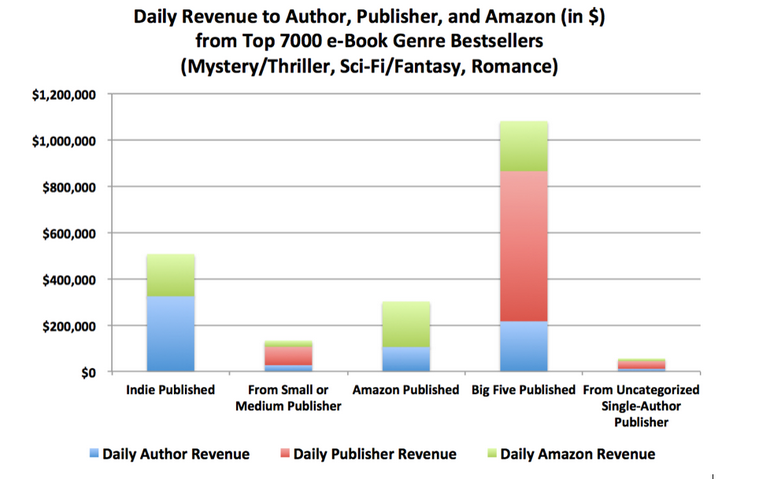
For the real, genuine lowdown on what is happening in publishing, who is earning what and how, read Hugh Howey's report here. Those of us who self-publish and keep up with information on the web have suspected some of this, but to see the figures and charts is just staggering. They are from Amazon US.

You need to read this, now. Here's just one of the fascinating charts:


Don't hang around here! Off you go!

EDIT: And there's more here: What Writers Leave on the Table (when they self-publish).

Sunday, 2 February 2014

JKR, I only hope you're reading this...


This week JK Rowling revealed she has changed her mind about the suitability of Hermione and Ron marrying and having two children called Rose and Hugo. (Too much information, anyway. I agree with Jason Black that tying everything up at the end of a novel is a Bad Idea - read his excellent piece here. You should leave the reader something to mull over.)

Nothing JKR can do about it at this stage, you mutter? There is! I came across this idea of genius on Kboards from Landon Porter, an open letter to JKR:

"I am about to offer you two words that will transform that mountain of money into a money continent. I understand completely how you might have overlooked it, but as a fan of comic books, it was thankfully not lost on me. 

Ready for the two words:

Alternate. Timeline.

Seriously, you've already introduced time travel into your universe with the time turner. It's time to stop worrying and love the paradox.

Imagine if you will, the loved ones of one of the victims of the final battle deciding to stop it before it even starts by using the time turner to go back to the first rumbles of trouble: the Chamber of Secrets scare. There (er... then) they set in motion events that end with Dumbledore explaining exactly what the book was then and setting up the quest to destroy the other clearly-no-a-lich's-phylacterys then and there.

Of course, this will involve sending his crack team of The Chosen One and plucky sidekicks and will put into play a whole new sequence of plots for a whole other series of books where you can rearrange your pairings however you want (and also let Sirius live).

As a bonus, killing Voldy early will allow the next set of movies to have a Big Bad who doesn't look like The Master from Buffy got it on with a seal."


I see no flaw in this plan.

Wednesday, 29 January 2014

If there's a button, why not push it?

My resolution for 2014 is to push more buttons, and I shall be actively seeking out new buttons to push. I'll also be giving up pushing old buttons that no longer work, which is a failing of mine. I find it hard to abandon something that has served me well in the past.

Jeff Bezos said, "If you double the number of experiments you do per year, you're going to double your inventiveness." He's also quoted as saying he doesn't think consistency of thought is a particularly positive trait. It's healthy to have an idea today that contradicts the idea you had yesterday. The smartest people constantly revise their understanding and reconsider problems they thought they’d already solved. They're open to new points of view, new information, new ideas, contradictions, and challenges to their own way of thinking.

You have to accept that most buttons you push won't make anything happen. Acknowledge that you're going to feel foolish and discouraged after several duds in a row - but still keep looking for another button to push.

So far, I've paid for a Bookbub ad (successful). I've got out my half-finished screenplay of Replica, finished it, and emailed it to a professional screen writer who was rash enough to volunteer to look at it. I've decided to leave KDP Select (again) and really try to make it work on the other platforms this time. And I'm trying to think up an idea for a series...

Monday, 20 January 2014

Do authors need editors?

My last blog post was picked up by The Passive Voice, and has so far garnered 285 comments. There's a lot of interesting stuff there, if you have an hour or two to read it. My eye was caught by a comment from author Kathlena Contreras:

My experience with people acting as "editors" is that they've tried to change how I tell my story. And ruined it in the process. My point is that we, as artists of the written word, should stop asking authority figures to validate our work and have some faith in the vision we're trying to communicate.

It's often stated on indie forums that no book will be the best it can be without the help of a professional editor. I think this is nonsense. While I'm sure a good editor can contribute to a book, a bad one can ruin it. I've never blogged about the critique that Remix won on Authonomy from an anonymous Harper Collins editor back in 2010. Not sure why - maybe I didn't want to appear unprofessional. This is part of it:

Here’s how you might take your story into the real world. In this darker alternative, instead of dossing down on the roof terrace of a penthouse flat [sic] in London, for example, Ric would be living in a ramshackle shed at the edge of some property in France possibly inherited recently from the protagonist’s mother/aunt etc. She could come to stay for a few weeks, figure out what she’s going to do. 

He was telling me to change the setting from London, which I know, to France, which I don't. Yup, that makes sense.

But she hears noises, she’s disturbed, thinks there’s someone threatening in the night… doesn’t know what to do… tension builds… next day, she has a poke around, finds evidence of someone living rough, at first she thinks he’s dangerous but then they meet (right there, we’ve gone from a few pages to several chapters with new beginnings, red herrings, tension, uncertainty, plot twists). 

Several chapters where all that happens is a timid woman meets her neighbour. Great.

I think its [sic] unwise to cast a world-famous, very handsome rocker who’s only recently disappeared [in fact three years before] but hasn’t disguised himself at all and has just climbed some tall building [actually three storeys] in Hoxton as a ‘mystery stranger’. Better for him to be more like a cult figure who hasn’t been seen for years – bearded, a bit bedraggled perhaps… but suspiciously well-kempt as if he has money. Then let the relationship build up for a while before the revelations

Revelations of what, exactly? If Ric's living openly he can't be a murder suspect, so there is no plot.

I remember having to read this critique two or three times before I believed it. I wasn't foolish enough to take any of its advice. But I pity the poor authors that particular HC editor works with.

Saturday, 11 January 2014

Why authors and trad pub don't reveal authors' earnings

Three days ago, a traditionally-published author blogged under the title: HONE$TY PO$T: An Average Traditionally Published Author's Pay. It's a full and frank disclosure of what she has earned over the past three years from her book deals with Harper Collins. You can read a cached copy of it here (EDIT: now expired, so I'm glad I copied it- cached because within four hours, the post was taken down.

Why was it removed? It's unusual for authors to tell anyone what their advance is, because advances these days are pretty unimpressive. You'll probably hear about it if it's what's referred to as a six figure sum. But mostly, so modest is the average advance, the author prefers to focus on her achievement of having a book deal with a major publisher; people have heard of Penguin or Simon & Schuster, and will be respectful.

And publishers don't want to disclose that they pay authors such beggarly amounts. It would certainly raise eyebrows - and maybe more authors would consider going indie. After all, where would publishers be without writers? Nowhere. Yet from the way they behave, you'd think writers are a minor and non-essential part of the business, who use up a lot of agents' and editors' time that could be more profitably spent elsewhere. Those agents and editors earn a living wage, while writers are advised not to give up the day job. Writers are right down the bottom of the publishing heap. Let me quote from that post:

"My books are paperback originals - no hardbacks - and I make 6% of the paperback sales, 25% of the ebook sales.  Publishers take a big chunk because they have a lot of employees to pay, and print costs are not cheap.  Of my percentages earned I share 15% with my agent and put away approximately 15% for taxes.  That means for every $10 paperback of mine that is sold I get $.60, and $.09 of that goes to my agent."

This writer is not complaining. In her own words, she is happy and grateful.

Roll on the revolution.

P.S. The author tweeted she had to take the post down for 'contract disclosure reasons'.

P.P.S. If you are curious to read the copy I took of the post and comments, email me: lexi14@hotmail.com

Monday, 6 January 2014

Why isn't an older mitten a mat?

From Donna Wilson
I came across this charming rhyme posted as a comment on a Facebook thread, and can't resist copying it to my blog.

The Kitten sat on the Mitten

And the young of a cat is always a kitten,
but the young of a rat is never a ritten
and conversely a kitten when older's a cat
so why isn't an older mitten a mat?

Michele Brenton, aka Banana the Poet, has published books of her witty and accessible poetry, which you can find (and buy for a modest price) here.

Wednesday, 1 January 2014

Woohoo! A new year!

My new year got off to a pleasant start with Wolf by the Ears finishing the month at #4 on the YouWriteOn charts, entitling it to a professional critique from Random Penguin or Orion. 

I used to be very active on YWO - I always say it's the place I learned to write - but I only put Wolf up to get more opinions on the all-important first chapters of the novel. The top ten is a bonus.

2013 had its ups and downs. It's getting more difficult to sell ebooks, though many indie authors are still doing extremely well. Persistence is, I think, the most important factor leading to success - certainly more important than talent. Publishing is still changing, and who knows what opportunities are just around the corner? We need to keep writing, stay nimble and fast and ready to take risks. In my opinion, trad pub is here to stay. After years of stoutly maintaining that ebooks were no cheaper to produce and handle than print books (a thumping lie) publishing houses are currently making a fortune from digital. But a big chunk of the market now belongs to self-publishers, and trad pub won't be regaining that lost territory.

Here's wishing all my readers a fantastic 2014.

Tuesday, 24 December 2013

Merry Christmas and a happy New Year!

City Traffic in the Rain from The Pipe Dream Daily
Wishing a

MERRY CHRISTMAS

 to you all, and may your dreams come true in 2014!

(I've chosen a rainy picture this year as we do seem to be having a great deal of rain right now in London.)

Monday, 16 December 2013

Messing with Amazon's head, or Jeff Bezos thinks I own a dog

The dog I don't have -
image from K9 Protection Dogs
Amazon has the most sophisticated algorithms in the world for knowing what its customers want in order to offer it to them. It's one of the secrets of their success.

I know I've misled Amazon about my reading tastes, since I so often click on the books in the signatures of fellow writers out of curiosity, to see how they are doing or to read their samples. But this week I realized, when viewing the Lightning Deals Amazon emailed me, that I've confused them about my entire lifestyle as well. I cycle, garden in a small way on my balcony, feed birds and have a weakness for tiny bright torches; they've got that right, even if they haven't twigged I wouldn't take a barbecue as a gift.

But now Jeff Bezos thinks I own a dog. He's currently offering me an assortment of dog beds, collars and eating bowls. And I know why. It's because there's a guard dog in Wolf by the Ears, and I researched the toy he'd be playing with. (A Kong, since you ask, this one.) Amazon's useful for finding items your characters own or buy, because its selection is so huge. A pity it doesn't sell property.

Of course, as a writer I'm even more misleading on Google. Recently I've exhibited an unhealthy interest in firearms, signs of surveillance, tracking by mobile phone, the FSB, undetectable poisons, post-mortems, fingerprints, toxicology, how long a corpse takes to float and how to hack a Sim card. Perhaps in my next book I'll include a villain who writes a novel as cover for the research necessary for his evil deeds...

Tuesday, 10 December 2013

New novel out ~ Wolf by the Ears


Today I hit Amazon's Publish button on Wolf by the Ears, my latest novel - an exciting and anxious moment. I do hope readers will like it. This is the synopsis (and you don't want to know how long it took to write, or how many people helped me with it):

When Tyger Rebel Thomson starts working for a Russian oligarch, she could be on her way to the life of her dreams – assuming, that is, she lives long enough to get there.

Grisha Markovic is a man with enemies. He’s loathed by the Kremlin, under observation by MI6, involved in acrimonious litigation over a Siberian gold mine, and rumoured to possess an explosive dossier containing details of a massive Russian tax fraud.

Grisha is impressed with Tyger’s intelligence; he takes a fatherly interest in her and makes her his personal assistant. This could be the break she has been hoping for. But after a mysterious driver tries to run her down, she begins to suspect that the death of his last PA may not have been an accident

I got the idea for the story when reading about the death of Boris Berezovsky. Interested, I started researching oligarchs, and realized just how many dubious deaths there had been in this country, all with Russian connections. We know assassins killed Litvinenko and attempted to kill German Gorbuntsov, who survived a hail of bullets on the doorstep of his London flat. What about Alexander Perepilichnyy, Badri Patarkatsishvili and Stephen Curtis? Those deaths were recorded as having 'no suspicious circumstances'. Like Litvinenko and Berezovsky, these men were enemies of the Kremlin, and believed themselves under threat.


You can view Wolf's sample on Amazon and decide whether to lay out £1.99/$2.99 in order to read on.

Monday, 2 December 2013

Chasing the last typo, considering commas, committing to the move

The paperback cover, still a work in progress
My latest novel is nearly good to go. A couple of beta readers told me it was comma-light, and they were right, so I've been judiciously adding commas.

Q pointed out that my disclaimer at the start of the book, While the places in this book are a mixture of real and imagined, the characters and events are fictitious, was not strictly accurate, since I mention Vladimir Putin and other real people. So I have made that line even shorter: This is a work of fiction. (I am in favour of keeping a book's front matter as brief as possible. The verbose disclaimers, threats towards pirates, and personal avowals that some authors go in for amaze me.)

I've formatted the paperback, and printed it out to check the way it looks on the page, which gives me the opportunity to have a final read-through. I've started work on the paperback cover. I have still to format the ebook.

At some stage, one has to admit the book is as good as one is going to get it. In Churchill's words, it's almost time to "kill the monster and fling him to the public" - which is both frightening and exciting.

Wednesday, 20 November 2013

Beta readers and Winnie the Pooh

Pooh murmured to himself

"But whatever his weight in pounds, shillings, and ounces, 
He always seems bigger because of his bounces."

"And that's the whole poem," he said. "Do you like it, Piglet?"

"All except the shillings," said Piglet. "I don't think they ought to be there." 

"They wanted to come in after the pounds," explained Pooh, "so I let them. It is the best way to write poetry, letting things come." 

"Oh, I didn't know," said Piglet.

This is an early example of a beta reader having his advice overruled by the author. Piglet's suggestion is correct, yet the removal of the shillings would not improve the couplet.

I've reached the end of my next novel, and I've started sending it out to beta readers. I don't send it to everyone at the same time, since I'm making changes as I get feedback and I want to get comments on the latest version. (Also some of my lovely betas are doing Nanowrimo.) I'm still obsessively tweaking the fight scene, too; in my experience fights take a lot of rewriting. It's very interesting, reading betas' suggestions. I've had three reports so far, and none of them have queried the same things, and they have all made some suggestions which I have leaped upon and incorporated, and others which I have not.

The variety of responses confirms me in my view that half a dozen good betas perform better than the average editor. I write for readers, not people working in the publishing industry, so it makes sense to have readers vet my books. I imagine it's possible for an editor to become jaded, or didactic. I like a nice mix of readers and reader/writers. Readers can tell you what's wrong, and a fellow author can often tell you how to fix it.

My betas so far have liked my latest novel. This is a relief. It's lonely, writing a book, and quite worrying waiting to see what readers make of it. I hope to publish in the not-too-distant future.

Tuesday, 12 November 2013

The Fussy Librarian

One of the biggest problems for readers and authors is to find each other. A brand new site called The Fussy Librarian aims to help with this. 

From their home page:

1. Enter your email address
2. Select what types of books you read
3. Indicate your preferences on profanity, sex and  violence
4. Get daily emails & enjoy great books
5. There is no step five*

This recommendation service has been going a month, and can only get better as the choices are refined and users give feedback. (I think people's definitions of mild profanity and non-explicit scenes of sex can vary wildly, and examples would help.)  Jeffrey Bruner says they plan to keep adding categories - there are currently thirty - and content options.

I think this could be good - I've joined, and you can too, here.

* I want a step five!

Monday, 4 November 2013

Do not trifle with readers' expectations

A couple of weeks ago Harper Collins published the third and final book, Allegiant, in Veronica Roth's popular trilogy. I'd actually bought a copy of the first book, Divergent, and got several chapters in when a horrible certainty came to me that Roth had sold the book as "Harry Potter meets The Hunger Games," and I went right off it.

Currently Allegiant is at number 5 in the US Kindle Store; it has 2,040 reviews with an average of 2.8 stars. Why the huge sales and the low customer ratings? Because Veronica Roth chose to end the series in a way that her readers hated. Here is a typical comment:

"I loved Divergent and Insurgent and was really looking forward to Allegiant. I don't recommend this book to anyone unless you want to be distraught and depressed for days afterwards. The first 300 pages are boring and totally detached from the plot of the first two books. The book picks up in the end only to leave the readers broken-hearted. There is no happy ending. There is no real closure. The author can do anything she wants with the final book and needless to say, I really dislike Veronica Roth as an author after reading this. Why end a once epic trilogy this way? I read books to be entertained and I was far from entertained. I recommend readers only reading the first two books and making up their own ending."

There is a compact between writers and readers; the reader will suspend disbelief, the writer will be true to the characters and the genre. How would we feel if Bertie Wooster suddenly murdered his Aunt Agatha? We would feel indignant and cheated, just like Roth's fans. I think there is an urge successful writers sometimes have to demonstrate they are really serious artists, prepared to shock and confound expectations. Doing this is generally a mistake.

It happens with screen writers, too. I still remember the final episode of MASH, where the writers, assured of a vast audience, decided to go all serious. Then there's the episode of Cheers where Sam discovers the dishy young woman accompanying an old friend is not his girlfriend but his daughter, and feels old and alone. This glum stuff is not what we watch Cheers for - we want to be amused, that's all.

It's difficult enough to write a good book without being wilful. Don't be wilful. Readers will not forgive you.

Saturday, 19 October 2013

Writers' & Artists' Yearbook, farewell and good riddance

I last thought it essential to possess a copy of Writers' & Artists' Yearbook in 2008. I was no doubt happy to hand over my £14.99 for their 101st edition, believing this was a step towards becoming a published author. Flicking through it now, it strikes me as all rather quaint.

Here's Alison Baverstock, writing a piece on How to attract the attention of a literary agent: "Think not what an agent can do for you, but what you can do for an agent", which is the exact opposite of my advice of what to ask an interested agent: "What can you do for me?" There's all the usual stuff about doing your research, meekly sending exactly what the agent wants, and waiting patiently and not bothering her as the months trail by. It's not called submission for nothing.

Little mention, in 2008, of self-publishing; one article mentions POD, with no suggestions as to how a writer can sell the books once they are printed.

In my copy I see I've turned down corners, crossed out non-fiction agents, and put lines and stars by the possibilities. So much hope: such a complete waste of time, effort, stationery, ink cartridges and stamps.

These days, Writers' & Artists' recognizes that a huge chunk of publishing is self-publishing, and have even got a section offering would-be indie authors advice. Unfortunately they, like most of the large publishers, have done a deal with the devil, Author Solutions (now owned by Random Penguin). A new writer filling in their handy form is very likely to be recommended to use one of the 'self-publishing services' of Author Solutions or one of their alter egos. He will then find himself subjected to a hard sell, and paying thousands of pounds for inferior and useless 'services' he doesn't need or could get cheaply elsewhere. He will end up sadder, wiser, and considerably poorer.

For more detail on W & A's perfidy, see David Gaughran, here.

And my old copy of Writers' & Artists' Yearbook 2008 is going in the bin where it belongs.

Sunday, 13 October 2013

The WIP's progress: 60,000 words

Those of you who hang on my every word (and I don't want to sound ungrateful, but shouldn't you get out more?) will have noticed my blog posts have been a tad less frequent of late. The reason is that in my spare time I've been working on my next novel  to the exclusion of much else. 

And today I hit the magic 60,000 word mark, which is my personal point of no return. It's not that all is plain sailing from here to the end of the book; I haven't written the end yet and I'm going to have to change some of what I've already written. It's just that if I get that far, barring accidents and disasters, I'm going to finish the darned thing whatever problems I encounter.

Because it's a lot of work,  attempting to pick the right 60,000 words and get them in the right order.

Monday, 30 September 2013

One word after another

For me these days the most difficult part of writing a novel is getting going on the first page. I don't recall having this problem with my first two novels, when I was still in the drunken woohoo isn't writing amazing stage. Now just deciding which novel to write can take me months.

With the WIP, I finally cracked it by taking the excellent advice of Jerry Cleaver in his book, Immediate Fiction. You commit five minutes a day to your novel; you also think about it before you go to sleep. And if you don't know what to write, that's fine, you just sit and do nothing for five minutes. If you want to work for longer, that's fine too. You do this religiously for thirty days without evaluating the plan's effectiveness. 

I think this method works so well because it gets the subconscious working on the book - and it's totally unthreatening. Anyone, no matter how busy, can find five minutes a day and do nothing. After thirty days I'd got a pile of notes and the novel was under way. My average word count is 480 per day, and the end is in view.

When you get right down to it, writing a novel is as simple as taking the White King's advice in Alice's Adventures in Wonderland:

The White Rabbit put on his spectacles. "Where shall I begin, please, your Majesty?" he asked.
"Begin at the beginning," the King said gravely, "and go on till you come to the end: then stop."

Wednesday, 25 September 2013

Smells in novels ~ but not much in Jane Austen

Smell is one of the senses we are told to use when writing a novel, and I totally agree; what can be more evocative than the smell of the sea, or honeysuckle, or a sudden whiff of the aftershave used by a long-departed boyfriend? But in the middle of the night when I should have been sleeping I had a revelation - there are very few mentions of what things smell like in Jane Austen's novels. This from Emma is par for the course:

Never had the exquisite sight, smell, sensation of nature, tranquil, warm, and brilliant after a storm, been more attractive to her.

There must be a reason for this. Smells must have been very different in Jane Austen's day, and I wonder if it was not thought genteel to comment on them. 

We are somewhat smug these days about smell - after all, London smells of cars, a mixture of exhaust, tyre particles and petrol, and before owners were compelled to pick up after their dogs, on a hot day Hyde Park had a distinct reek of dog excrement. When my daughter was small I remember constantly trying to stop her accidentally treading in it on the pavement. My workshop is in Hoxton, an area with a vibrant nightlife, and while women seem able to wait to get home to have a pee, many men don't. But it's unarguable that we wash more than the people in Regency times, simply because it's much easier for us to keep clean with running hot water, soap, shampoo, toothpaste, electric toothbrushes and deodorant. So when Jane Austen describes a ball, we can only imagine the smells as the room got warmer and dancers more heated. She is not going to mention them.

How fortunate for us we live in less correct times and are allowed to describe everything our senses record. Any writers reading this are welcome to post a brief extract from their novels that deals with smells, nice or nasty.